Feeds:
Posts
Comments

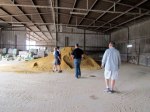
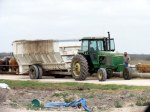
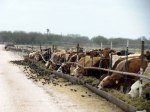
An intriguing thought – a steak from cattle who have been fed on oranges, grapefruit, watermelons, corn meal and minerals! The Tractor Club at VP in Texas has arranged for us to tour a 700 acre ranch where Giovanna Benitez will show us how she uses the abundant fruit in the area to feed her cattle and fatten them up for market. She shows us the hay, ground up fruit, and supplements which are put in giant white tubes to be turned into acceptable feed. A long process involving her 5 workmen and big equipment, her explanations, as she leads a drive around the ranch, are excellent and the members of the club are impressed with this 22 year-old woman (the youngest rancher in the area) who is innovating this feed and hopefully will succeed in making her ranch profitable. She explains that if you buy cattle at $1.65 a lb. (as she did) and sell it at $1.37 a lb. ( the current price) you can innovate away and go broke. All my tour mates and I are crossing our fingers that the price will rise and Giovanna will sell at $2.00 a lb. Good Luck, Giovanna!!

Meet Ray DeCatur

Meet Ray DeCatur

Ray Decatur

Ray DeCatur

Ray Decautur, Sculpting a female face

Ray DeCatur, Sculpting a female face

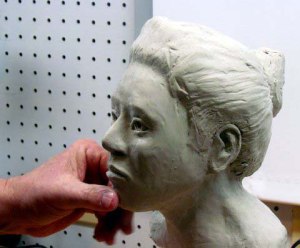
Head to Foot the human body is a marvel. Sculpting the face, which has 43 muscles, is a challenge that Ray has taken on. Here is his bust of a girl done in clay which will eventually be cast in bronze. Working with clay to achieve the desired expression of a face is a monumental task. Ray, being a meticulous workman, works and re-works the clay in an effort to reach his final goal. The slightest change of how a muscle is shaped produces an entirely different expression on the face of the young woman.  Very tricky !!

Best Foot Forward by R. Decatur

Best Foot Forward by R. DeCatur

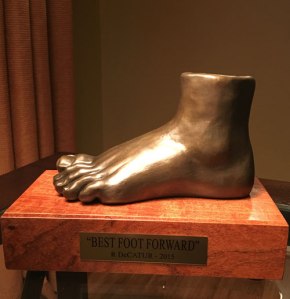
Amazingly, the foot has 100 muscles, tendons, and ligaments. Here is a foot done by Ray.


The art of casting metal sculpture dates back into ancient times but we have few examples since metal was melted down and reused for war and farm implements.  In The 1900’s it became popular due to the Industrial Revolution which provided new tools for the foundry ( a workshop for cast metal). It was the rage to immortalize warriors, statesmen and writers with a statue in their honor.  Today there are a few foundries still in the United States, one of which is the University of Texas Rio Grande Valley, where Ray cast his foot in bronze.

Ray Decantur with Sculpturee

Ray Decantur with Sculpture


Sculpture by Ray Decantu

Sculpture by Ray Decantur


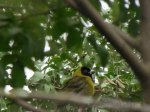
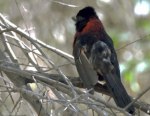
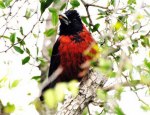
We begin the New Year, 2016, with a trip to the overgrown, mysterious, Frontera Thicket. It is quiet as we wend our way down the path to sit at a bird feeding station. Soon several people rush by us and we shout, “What are you looking for? What have you seen?” One person turns, cup her hands around her mouth, and calls back “It’s the female Crimson-collared Grosbeak!”

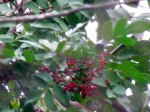
We leap to our feet and follow them to a fence where a Brazilian Peppertree is loaded with red berries and two dozen pairs of binoculars are trained on the tree. “Oh, the Grosbeak must have flown away,” one person says with disgust. Everyone dribbles down the muddy path looking right and left. I stay, hoping the bird will return to the luscious berries.

And then she does! She teases me by perching in the backside of the tree so I struggle to focus through the tree branches, I get a lucky shot of her with her plain, greenish-yellow body and black head. Five years earlier I succeeded in recording a male Grosbeak with his splendid red (crimson) collar and now I have a matching pair of photos of this rare bird. Rare to the United States that is … it is more common in eastern Mexico.

A disconsolate group comes back up the path and are overjoyed to hear I saw the prize at her favored spot. They settle down for another try.

Home we go with happy hearts as the light rain stops and the sun breaks through the drifting clouds. A wonderful start to a New Year.

Seeing Doyle Lavern

A humid, muggy, afternoon in the depths of September and the drawing class milled restlessly waiting for the model to arrive and start posing. Time passed, as it always does, and still no model. I approached the instructor and asked “What is the holdup?” Angel Berrios smiled faintly and replied, “The model has not come. I’m trying to decide if I should dismiss the class.”

Normally I would sigh to myself and wander back to my car but I have driven thirty miles to attend this figure drawing class. I want to draw! “How about I get my husband to pose for the class?” Now, I am not sure I can persuade Doyle to pose but desperation leads me on to say “I’ll go get him. He is reading in the car.”

Angel looks surprised, but agreeable, and off I go to the parking lot to try to cajole Doyle into modeling. He refuses, looking scandalized, but I persist telling him he can keep his shorts on and just take off his shirt. Finally he agrees, saying, “Why would the artists want to draw a seventy year old man?” “We don’t care! We don’t care if you are old. In fact, it would be interesting to have a model that is not young and buffed,” I assure him.

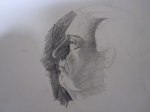
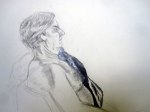
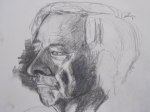
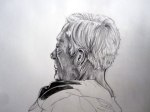
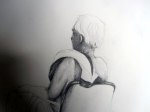
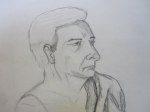
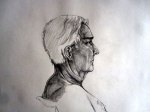
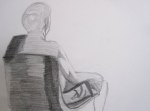
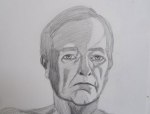
Away we go back to the classroom and he sits on a stool that spins and we all draw the lovely shirtless guy with the gray hair. Here are some of the drawings I have kept and enjoy looking at every so often. The variety is wonderful. We all looked at the same person. Here are the drawings.

And here is the real guy:

The Real Doyle Lavern

The Real Doyle Lavern

It was his eightieth year to heaven and we all gathered in the Moose Hall in the small Central Valley town where Wayne ran a Rodeo every summer for years. He is known all over the area as “Cowboy”. A steady stream of grizzled men in cowboy hats came thru the bar, obtained a drink, and stood in irregular circles congratulating Wayne on making it to eighty. Barbecued beef, macaroni salad, potato salad, and more delicious eats stood on a table but the guys preferred their drinks while we women and children gladly filled our plates.

A lively young couple began an intricate description of the acreage they had just bought to better house their 20 dogs, 13 cats and a few various other animals. Leanne told me she had found a horse tied to Wayne’s fence, abandoned by someone, and so they needed more room for all the animals she had rescued. Her husband, a handsome, genteel man looked askance at this. Wayne interrupted and waved his glass around saying “No one ever tied a horse on my fence!” He looked significantly at Leanne.  She colored and said to me “Oh. I lied to my husband. Actually the horse had been abandoned and was at the pound. I couldn’t bear to leave that poor horse in the pound.”

Giving Don an apology hug, which he accepted graciously, she then dragged out her phone and showed me trays and trays of blueberries on her dinning room table which they were selling and which were grown on their new purchase near Lake Comanche. She and her hubby are now in the blueberry business. “Wow! How much land is devoted to blueberries?” I ask, astonished that they grow in this valley. “I thought they were grown in wet marshes.” She dimpled up and glanced at Don. ” We have one acre and they are bush blueberries, four feet high, and we had no idea we were getting into the blueberry business when we bought this place. It is a steep learning curve and people call all the time and ask us for “our blueberries” as if we knew who they were. Being new owners we don’t know them but they come over and buy 50 lbs and take them home and freeze them. We never intended to be sellers of blueberries, just to have room for all our rescued animals.”

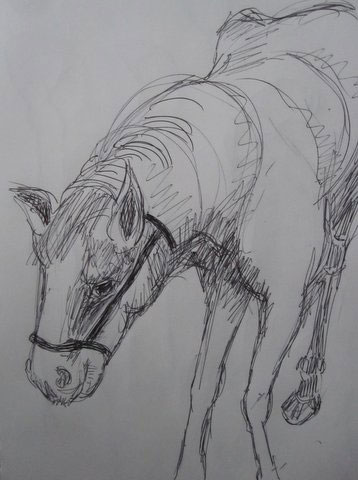
Pebbles, by Mary P. Williams

Pebbles, a drawing by Mary P Williams

I thought of all the horses pastured at Wayne’s ranch and of the one I had drawn a year earlier. He would whistle and Pebbles would gallop over to be fed while I drew. This year, with the drought and no water for pasture, the number of horses had to be reduced since $15 for a bale of hay prevented any profit from boarding horses. Don and Leanne have boarded 4 horses with Wayne and now must move them. Wayne and the guys drifted into a commiseration about the lack of water and the price of hay. All conversation halted as a stunning chocolate cake was brought forth. Singing, laughter, and another round of drinks accompanied servings of this four-layer sugar castle. Happy Birthday to YOU, Mr. Wayne Cummings!!

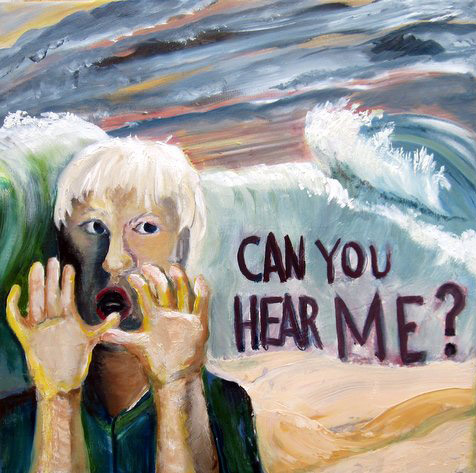
"Can You Hear Me?" by Mary P. Williams

“Can You Hear Me?” by Mary P. Williams

How did this reversal happen?

Ten short years ago people came to my office and listened carefully as I explained the intricacies of “the real estate deal”. There was pleasure in the interaction and conversation about this subject and many others.  The most interesting thing about my job as a Real Estate Broker was listening to the clients describe their own jobs and their lives. Fascinating explanations from intelligent, innovative people who loved telling me about their visions of the future.

Sandwiched between viewing one house and another house they told me how the Internet would eliminate the use of paper. How business would be done without a face-to-face meeting of broker and client. Neither of these propositions happened. The  joy with which they described the speed with which a person could buy the home they would live in and the elimination of useless “personality” in the transaction amazed me. Was it possible that the prospective buyer could simply look at staged photos of a house and buy it from thousands of miles away? What about the intangibles of weather, neighborhood, and those stately trees which add so much to the quality of life?

As they described this future world they ambled thru a house and commented on the lack, or abundance, of light and “how the moon would look seen thru this window.” The rose garden on this property and the raked zen paths on that property were compared and aesthetic decisions were arrived at. None of this could be done at a distance.

The key ingredient in the selection of the “perfect” house for the individual was the presence of a person to listen as the client talked about their desire for this or that ambiance. That was the function of the Broker … to listen and reflect back to the person a list of “needs” and “wants”. Two very different values.  I only “need” two bedrooms/one bath but I “want” four bedrooms/two baths. Listen, listen, listen.

Then came the longed for and dreaded RETIREMENT.  My young, active, movers-and-shakers were replaced by older, settled people in communities for ‘Over 55 Adults’. People who were uninterested in current affairs, politics, and who the latest artist/writer/filmmaker was and which newly opened restaurant had divine food combinations/far-out interior design. Yikes!

Who am I to talk to and listen to now ? My preference is to have face-to-face contact which provides subtle clues … body language, intonation, and facial expression meld together to give a whole sensory experience which cannot be achieved by texting a person. Yikes indeed!!

Oh, for the chance to listen to a brilliant person scintillate in front of me. “ Spouting off” is what I believe some folks would call it … I call it “creative thinking out loud” and it was the thing which characterized San Francisco in the 1980’s, 1990’s and the early years of the 21st century. I miss the enthusiasm with which they talked, debated, visualized, shouted, muttered, sang and otherwise expressed the joy of conversation.

Can you hear Me ?

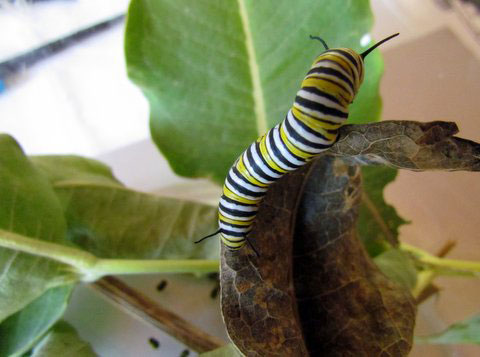
Monarch caterpillar on milkweed

Monarch caterpillar on milkweed

The caterpillar and the milkweed cleave one unto the other. Unless the Monarch butterfly can find a milkweed plant to lay her eggs on her future caterpillars are doomed. Oh, one asks, “Why must it be only milkweed?”  There is no answer in the rich mosaic of choices which were made thousands of generations ago by the ancestors of the awesome monarch butterfly.

Why do they hang in clumps in certain trees? Why this tree and not those trees? It appears that the choices are hardwired into each individual and the success of the species depends on the individual repeating the instructions verbatim.

Is our behavior governed by some imperative of which we are unaware?

There are the patterns that butterflies follow … and the patterns that the milkweed plant, with its elegant pods, follows.  At what time and temperature will the pod release its floaty white seeds? Will the seeds grow at the right time to match the need of the caterpillar for succulent foliage to browse upon? Our mysterious world and its magic!

Milkweed pods and their silky seeds

Milkweed pods and their silky seeds

Serendipity puts us in Vienna, Austria on July 1, 1993 where we pluck the name of Prague out of thin air and decide we will go there to see the newly “freed” country of Czechoslovakia which is surviving the split with Communist Russia. Our waiter at the café where we are breakfasting has said with a sneer “The peasants in Czechoslovakia are overjoyed at the new government who will give them prosperity, cars, clothes, and food. They are deceiving themselves for sure.” My husband I glance at each other, at the café with glass cases of rich pastries, and ask my sister Josie, “Shall we go there?”

We have been treated to many lyrical, romantic descriptions of Prague by George Mraz, a scientist, who defected from the Czech Communist Party while working at the Lawrence Lab in Berkeley. He constantly claimed that “Prague is the most beautiful and cultured city in the world” as he rhapsodized about his home country. Should we go there and see if they are celebrating? Is there celebration? Or is there a frozen public who are cautious and fearful of embracing anything new?  Josie says “ Let’s go!”

It is a short train ride, we have a Eurail pass, an unplanned day or two, and adventurous Josie, who is traveling with us to Sweden where my son is marrying a Swedish woman. The proverbial three country mice visiting the glittering Continent. It is hard not to be intimidated. While Vienna is opulent,  cosmopolitan, and expensive, it is too rich, too chic, and Josie wants to see the stone castles and churches of old Prague.

On to the train we go and soon reach the border where we present our passports and transfer to another local train.  This train is shockingly shabby and dusty with hard seats, dirty windows, and no dining car or other amenities. It rattles, it creaks, and we all gaze at the countryside which is rural and green; very similar to the country side in California where we grew up on farms surrounded by work waiting for us to do it.

Arriving in Prague, we inquire about a hotel, check our dwindling funds, and note that the sun is setting. The station master hands us a brochure, points to a picture of a modern 1950’s style concrete building, and summons a taxi to take us there. They do not speak English and we speak nothing but English forcing us to communicate by nods and waving hands.

It is twilight and there are no twinkling lights to brighten the streets.  The taxi bumps over roads made out of cobblestones which are in poor condition. Cobbles that are missing yield deep holes that the tires struggle to bounce out of with jerks.  This is a rough ride indeed.
Prague by Mary P William

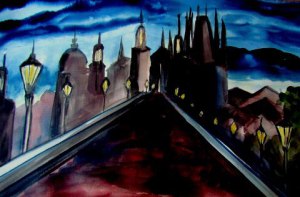
Prague by Mary P Williams

The feeling in Prague is dark and melancholy.  Out of the dusk the croaks of many frogs booms forth; a country sound in the city. Our hotel appears and we check in.  Luckily for us the hotel clerk speaks excellent English.  He is from England, recently hired we guess, as he does not seem to be totally in control of the paperwork. He is an attractive, well dressed, thin, young, man with spiky hair and bright, knowing eyes.  As he registers us he informs us that we have come at a time when all is in change. “The country is now two new, divided states … Czech Republic and Slovakia as of Jan 1,1993.  In 1992 Havel was elected leader and helped divide the country into two countries.” He tells us he is here because there is great opportunity when events such as this occur.

He looks at us thoughtfully and remarks  “You will see many students from Europe here because it is so cheap to live here, there are lots of jobs with so much work to repair all the buildings which fell into disrepair during the rule of the Communists. Many are living on the streets out of their backpacks to save money. Do not be distressed as they are not beggars but respectable students. Everything is shabby here and we all have to work hard to gain a measure of prosperity.”  He concludes his remarks by giving us a hand drawn map of the streets around the hotel with a restaurant marked on it and the advice to go there as it is the only place open.

As he mentions “restaurant” hunger grips us and off we go with our little map.  It is so dark with no street lights and we are slightly apprehensive. Three blocks from the hotel there is a faint glimmer of light from what looks like a storefront, yet there is no sign, no indication that it is a public place, but we have our map. Without light we cannot read it so we timidly go to the door and it is opened by a tall, black-coated man who gazes at us sorrowfully.  Are we in the wrong place ? Gradually he inches the door open and we step into a dim, pleasantly warm room with six tables graced with white tablecloths. Ah! We have found the restaurant.

He stiffly walks ahead of us and bows us to a table.  We are the only customers it seems.  Our quandary continues as we do not know how to order.  He gestures imperiously to a curtain and a young boy slides from behind the curtain and asks us “Food? “ We nod. “Alcohol?” We nod.  He disappears.  Reappearing with three thimble-sized glasses he pours a colorless liquid into the glasses and vanishes. It is Slivovitz … like drinking turpentine … D.L. and I  try not to sputter and spit it out and Josie knock hers back with a gasp.

“Remember when George Mraz was so thrilled by the shelves and shelves of booze in the Berkeley liquor store that he almost cried?” Josie asks as she drinks D.L.s left-overs.  George became a friend and we grouped together to teach him English, buy him some clothes, and teach him to drive Josie’s Volvo at three am when there were no other cars on the streets of Berkeley. He never learned to drive in Prague, was barely surviving, and we were rich Americans in his eyes. Funny, we did not feel rich as we had the usual debts … mortgage, car payments, children in college.  He recalled the beauty of Prague and got drunk on Slivovitz.

Our original waiter stands at attention near, but not too near, our table.  The boy reappears and asks “Music?” We all nod and an old, old man with a violin steps from another room and begins a lovely, lilting melody.  He nods to us, we nod to him, and the waiter approaches and holds out his hand. We look blankly at each other until comprehension floods across us … he is to be paid. How much? In what currency? Doyle takes out French, U.S. and Italian money. The waiter delicately picks out from the assembled money what is necessary and hands the rest back.

Dinner arrives with a first course of borscht soup.  Borscht made of beets, carrots, cabbage, onions and dill weed. It is a big, delicious bowl of soup served with crusty bread.  Both the boy and the waiter watch intensely every bite we take and once the boy licks his lips. The music plays, we eat, the waiter and the boy stand at attention and then with no ceremony the waiter comes to our table and gestures for money again.

Suddenly I realize that this is all the food they have, dinner is over, and we have eaten their dinner. I am truly horrified … the boy is so thin … the man is so thin … the musician is so thin.  What have we done? Shame fills us as we fill the hands of the waiter with as much cash money as we have on us. We  try to apologize but the waiter lifts his head, again imperiously, and gestures to the door.

We stumble out into the quiet, dark street and hurry back to the hotel.  I rush up to the clerk, who speaks English, and babble “Why didn’t you tell us they have so little food? We ate their little bit of food!”  Without a blink he smoothly says “They need your U.S. dollars and tomorrow they will go to the country and have the money to buy lots more food.  Everyone in this country has spent years being hungry and learning to deny their stomachs. Do not worry. They are happy with the money and will eat tomorrow.”  The three of us look at each other doubtfully as we remember going to bed without supper in our long ago childhood.

We go to Josie’s room to huddle and see what money we have left.  The decision to train around Europe while attending the wedding was based on each of us having a credit card with enough credit left on it to allow us to take a once-in-a-lifetime trip and return home with the dreaded “debt” word scrolling over our heads. Now we have given our cash to the restaurant and credit cards don’t work well here. Tomorrow we will have to approach the desk clerk with a request for funds … but now, too weary to care, we carry our distress for the hungry family and our distress for our lack of cash to bed with us. George’s longing for beautiful, civilized, Prague lies in the distant past.

We thought we were visiting the Czechoslovakia George described but in reality we were visiting the Czech Republic, a small, broken country recovering from decades of deprivation.

Tubac Hummer by Mary P Williams

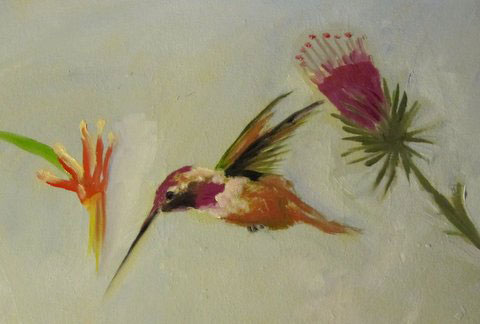
Tubac Hummer by Mary P Williams

When the first rays of light reveal a ghostly world I sneak quietly out the Tubac Country Inn door and step down to a desert landscape.  Next to me is a towering cactus plant with gobs of spider webs strung between its long, sharp thorns.  Formidable is the term that leaps to mind.
Standing still I gaze at a spiderweb with tiny insects trapped in the web. Suddenly, a whirring noise by my ear and a flash as a hummingbird hovers inches from my nose. He darts forward, seizes an insect from the web, and eats it. I am astonished and stay still as a stone. He then proceeds to pluck the insects the spider caught during the night from the web, one by one, and delicately snack on them. When that web is cleared he moves to the next, and then the next.

The spider is invisible and does not rush forth to defend his breakfast … perhaps wisely, as he might also look tasty to the hummer. At a minute movement from me the flashing jewel is gone and I am left in wonderment … I did not know that hummingbirds were insectivores … I thought they lived exclusively on honey and nectar from wildflowers.

This is a marvelous morning and it is dedicated to Mark D’Avignon who travels his Zen Path with grace.

Sierra Triptych by Mary P Williams

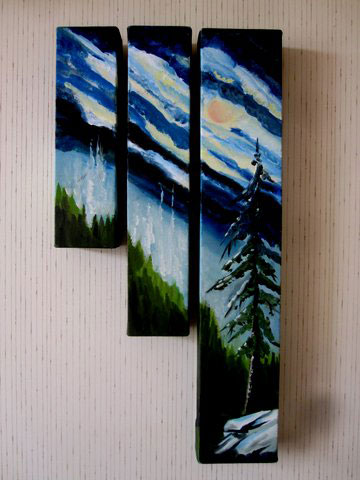
Sierra Triptych by Mary P Williams

“Midnight at the Oasis” was a love ballad sung by Maria Muldaur extolling the virtues of love. It is now midnight in the Sierras and nothing could be more the reverse.  Here, no warm breeze to tease and tickle the bare skin but a chilly wind out of the North as my “sheik” slumbers wrapped in a down comforter.

There are “traces of romance” in the song and in my heart which remembers many years ago the gambols of young human animals experimenting with their bodies. Seventy five years down the road I cannot “slip off to a sand dune…and kick up a little dust” but I can gaze out the window at a full moon glazing the tops of the mountains and the shining billows of cloud and remember.

Four hours away are the warm sand dunes and cactus of Death Valley and fifty years in the past Maria sang with a pure, lustful voice of the pleasures of the body.  The pleasures change with age and the pleasure of lying next to my husband’s warm, sleeping body and slipping a hand onto his fragrant hairy chest brings a smile to my face. His skin is soft from the hot lavender bubble bath he took two hours ago.  What do they say? “Everything is relative.”

Rising to don a bathrobe, I bare-foot it out to the frosty grass where the moonlight is so bright that only three, or four, stars are able to send their long-ago light into my eyes. The rest are obscured by the brilliance of moonbeams.  Going out with a cup of hot tea and a blanket is a shockingly cold wake-up. It is so silent here at the top of the mountain that my ears ring without noise. Then the tiny night noises begin with the low hoot of an owl and the squeak of a mouse. In the meadow a coyote yips his presence to all of his species. We, the owl, the coyote, the mouse and me, are occupying the same moment together and it is a splendid moment, never to recur.

This moment is all the dearer with the assurance of being able to return to the warm man and his pile of covers.